1️⃣ Why Message Queues Exist
Problem Without Queue
Imagine Instagram photo upload flow:
Client → Server → Resize → Filters → Moderation → ResponseEverything happens synchronously.
Problems
- ⚠️ High Latency
- User waits for all processing:
- Resize image
- Apply filters
- Run moderation checks
- Response may take:
5-10 secondsBad UX ❌
- ⚠️ Fragile System
- If one service crashes:
Moderation service fails - Entire upload fails.
- Already completed work gets wasted.
- If one service crashes:
- ⚠️ Bursty Traffic
- Example:
Normal traffic: 50 req/sec Spike traffic: 50,000 req/sec- Servers cannot handle sudden spikes.
- Requests fail or timeout.
2️⃣ Solution: Message Queue
Architecture
Client -> Upload Server -> ⭐ [Message Queue] ⭐ -> Worker Pool -> Image ProcessingFlow
- Upload server stores image.
- Server pushes message to queue:
Photo 456 needs processing - Server immediately responds to client:
Upload successful - Workers consume messages asynchronously.
4️⃣ Core Benefit: Decoupling
Producer and consumer do NOT know about each other.
Benefits
✅ Independent Scaling
More uploads?
Scale producers.

Heavy processing?
Scale consumers.
✅ Better Reliability
- Consumer crashes?
- Queue still stores message.
✅ Async Processing
Slow tasks move to background.
Exmaple:
- Waiter places order and leaves.
- Cook processes later.
- Exactly how queues work.
6️⃣ Acknowledgements (ACK)
Problem
What if worker crashes while processing?
Without ACK:
Message gets lost forever ❌Solution
Consumer must explicitly acknowledge:
ACK = "Processing completed"Only then queue deletes message.
Flow
Consumer receives message
       ↓
Processes message
       ↓
Sends ACK
       ↓
Queue deletes message
7️⃣ Visibility Timeout
Problem
While Worker A processes message: Can Worker B also process it?
That causes duplicate processing.
Solution (SQS)
Message becomes: Invisible for 30 seconds Other consumers cannot see it.
If worker crashes: Visibility timeout expires Message becomes visible again.
8️⃣ Delivery Guarantees
Very important interview topic ⚠️
1. At Least Once Delivery ✅ (>=1) (Most Common)
- Every message gets delivered:
At least once - But duplicates may happen.
- Requirement:
- Consumers must be →
Idempotent(Running same operation twice gives same result- Good Ex. Set profile photo = photo_5 ⇒ Running twice ⇒ Still photo_5
- Bad Ex. Send 10 rs to OM ⇒ running twice total 20rs
- Consumers must be →
- Interview Recommendation ⭐
Use at-least-once delivery
with idempotent consumers
2. At Most Once Delivery - 1 or 0
- fire & forget - Message may be lost. But never duplicated.
- Best case - Atmost one guy processed it
- At worst - nobody processed it
- Where small data loss is acceptable like below
- Useful for:
- Analytics
- Metrics
- Logging
3. Exactly Once Delivery - 1
- Meaning - Message processed exactly one time.
- Reality: Very difficult in distributed systems. (Complex and expensive.)
- Interview Advice
- Avoid claiming:
Exactly once delivery - Unless you can deeply explain implementation.
- Avoid claiming:
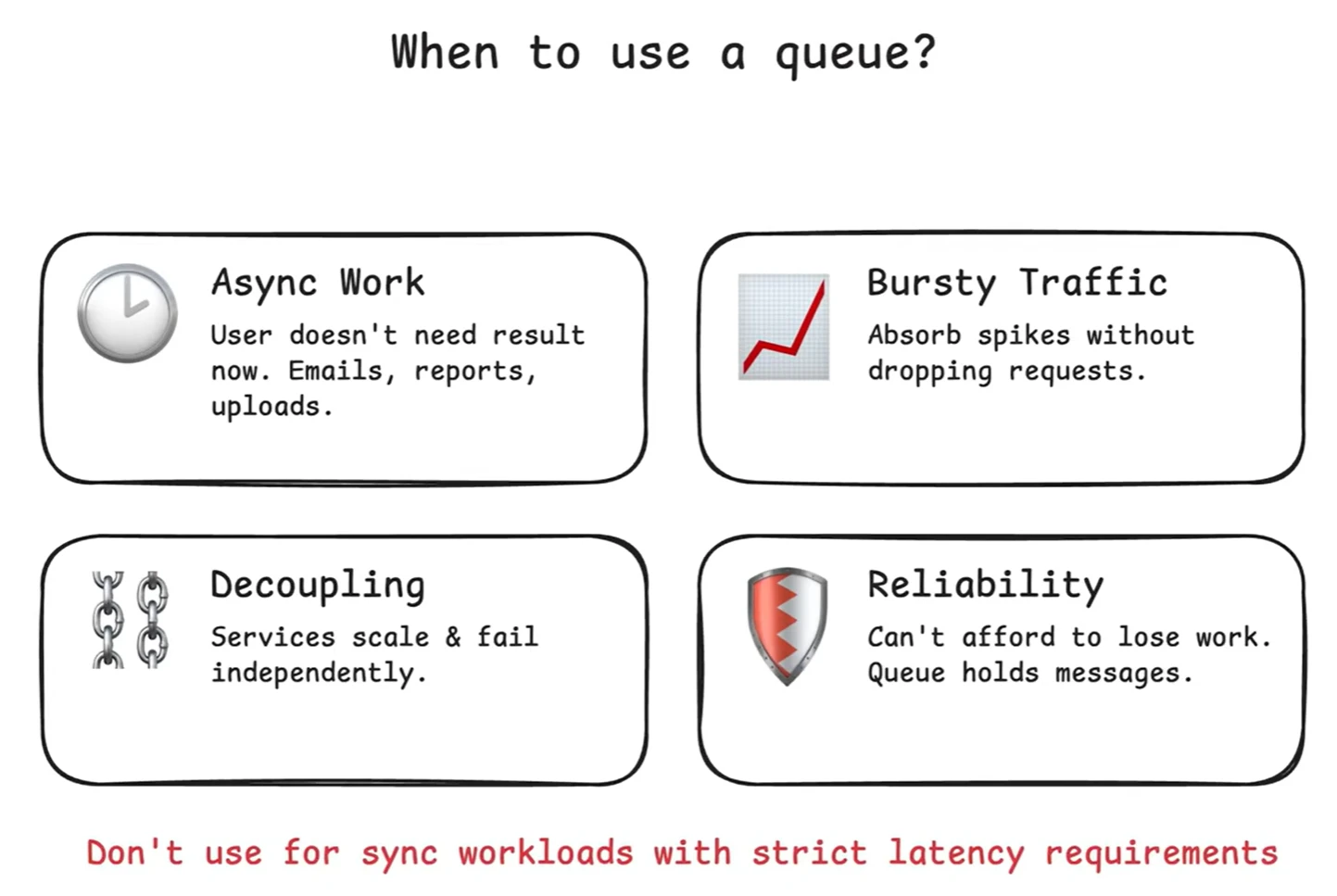
9️⃣ When Should You Use Message Queues?
Ask a Question - the user need the result of this operation right now or can he wait a little bit
🔟 When NOT to Use Queue
Synchronous Workloads ❌
If requirement is: < 500ms response time - Queue may violate latency requirements.
Queues are mainly for: Async background processing
1️⃣1️⃣ Queue Scaling
Problem
Single queue has throughput limit.
Solution: Partitioning
Split queue into multiple partitions.
Partition 1
Partition 2
Partition 3
Each processed independently.
Benefit
Parallel consumption. Higher throughput.
1️⃣2️⃣ Consumer Groups
Definition
Pool of consumers sharing partitions.
Example
6 partitions
3 consumers
Each consumer handles:
2 partitionsImportant Rule ⚠️
Consumers <= PartitionsExtra consumers stay idle.
1️⃣3️⃣ Partition Key
Extremely important topic.
Purpose
Determines:
Which partition receives messageGoals
| Goal | Why Important |
|---|---|
| Ordering | Related messages stay together |
| Distribution | Load spreads evenly |
Banking Example
Operations:
Deposit $100
Withdraw $50
Must happen in order.
Correct Partition Key
account_idBoth operations go to same partition.
Ordering preserved ✅
1️⃣4️⃣ Hot Partition Problem
Bad Partition Key Example
Partition by cityResult:
New York overloaded
Small city idle
This is:
Hot partitionBetter Key
ride_idMore evenly distributed.
1️⃣5️⃣ Back Pressure
Problem
Producers faster than consumers.
Example:
Incoming = 300 msg/sec
Processing = 200 msg/sec
Queue grows forever.
Important Concept
Queue does NOT solve capacity problem.
It only delays it.
Solutions
✅ Autoscaling
Add more consumers.
✅ More Partitions
Increase parallelism.
✅ Back Pressure
Slow producers down.
Example:
429 Too Many Requests✅ Monitoring
Track:
- Queue depth
- Consumer lag
- Processing time
1️⃣6️⃣ Poison Messages ☠️
Problem
Some messages always fail.
Example:
Corrupted imageRetries forever.
Consumes resources endlessly.
Solution: Dead Letter Queue (DLQ)
After max retries:
Move message → DLQBenefits
- Main queue continues
- Failed messages isolated
- Easier debugging
Interview Tip ⭐
Mention DLQ proactively.
Strong senior-level signal.
1️⃣7️⃣ Durability & Fault Tolerance
What if Queue Crashes?
Modern queues:
- Persist messages to disk
- Replicate across brokers
Kafka Feature
Messages retained for configurable duration.
Example:
1 day
1 week
Forever
1️⃣8️⃣ Message Replay
Huge Kafka advantage.
Consumers can:
Re-read old messagesUseful for:
- Bug fixes
- Reprocessing
- Recovery
1️⃣9️⃣ Popular Queue Technologies
Apache Kafka
Best for:
- High throughput
- Distributed systems
- Streaming
- Replay support
Features
| Feature | Supported |
|---|---|
| Partitioning | ✅ |
| Consumer groups | ✅ |
| Replay | ✅ |
| Durability | ✅ |
Amazon SQS
AWS managed queue service.
Types
| Queue Type | Characteristics |
|---|---|
| Standard Queue | High throughput |
| FIFO Queue | Strict ordering |
RabbitMQ
Traditional message broker.
Good for:
- Complex routing
- Enterprise workflows
2️⃣0️⃣ Kafka vs SQS vs RabbitMQ
| Feature | Kafka | SQS | RabbitMQ |
|---|---|---|---|
| Managed | ❌ | ✅ | ❌ |
| Replay Support | ✅ | ❌ | Limited |
| Ordering | Per partition | FIFO only | Queue level |
| Throughput | Very high | High | Medium |
| Complexity | High | Low | Medium |
| Best Use Case | Streaming | Simple async jobs | Routing workflows |
2️⃣1️⃣ Common Interview Deep Dives
Interviewers LOVE these ⚠️
Be ready for:
Scaling
- Partitioning
- Consumer groups
Ordering
- Partition keys
- FIFO guarantees
Reliability
- ACKs
- Retries
- DLQ
Capacity
- Back pressure
- Autoscaling
Fault Tolerance
- Replication
- Persistence
2️⃣2️⃣ Interview Cheat Sheet 🧠
Best Default Answers
| Question | Recommended Answer |
|---|---|
| Delivery guarantee? | At least once |
| Duplicate handling? | Idempotent consumers |
| Failed messages? | DLQ |
| Scaling? | Partitioning + consumer groups |
| Traffic spikes? | Queue buffering |
| Ordering? | Partition key |
| Queue durability? | Replication + disk persistence |
2️⃣3️⃣ Important Keywords
Producer
Consumer
Partition
Consumer Group
ACK
Visibility Timeout
Idempotency
DLQ
Back Pressure
Replay
Hot Partition
At-least-once Delivery
2️⃣4️⃣ Final Summary
Message Queues Help With
✅ Async processing ✅ Traffic spikes ✅ Reliability ✅ Decoupling ✅ Scalability
Core Tradeoff
Higher reliability
vs
Higher complexity
Golden Interview Line ⭐
I would use at-least-once delivery
with idempotent consumers,
partitioning for scalability,
and DLQ for failed messages.